Ultraformer MPT ultrasound lifting
A focused-ultrasound approach to selected lifting and tightening concerns. Ultraformer MPT uses ultrasound energy rather than laser or radiofrequency.
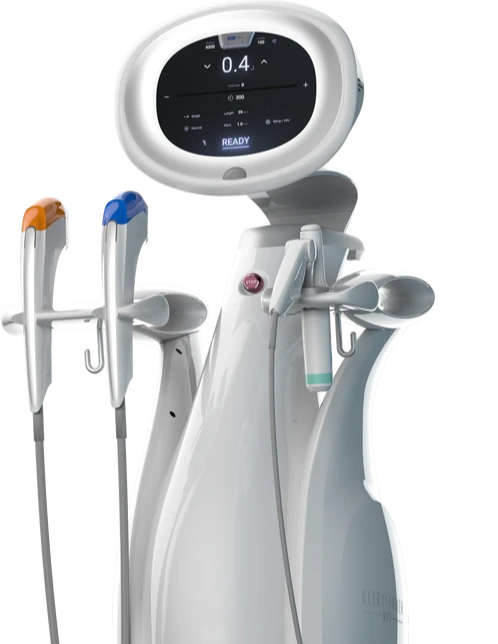 Ultraformer MPT
Your care, step by step.
Assess the target
Identify the concern, skin or body area and suitability.
Plan the sequence
Agree the technology, timing, recovery and expected course of care.
Planned treatment
Carry out the agreed approach and provide the specific aftercare.
Recover & review
Follow aftercare and review the response before any further treatment.
What to plan for
Your clinician considers the treatment area, tissue and anatomy before choosing cartridges and planning review. It is not a replacement for a surgical assessment when surgery is appropriate.
The sequence, session count and intervals are agreed individually. This is a pathway, not a fixed calendar.
An informed choice.
What the evidence can tell you — and where its limits matter.
Sources checkedEvidence & expectations
Focused ultrasound can be discussed for selected laxity concerns. Immediate 3D measurements in a cohort do not prove the duration of a result or make this protocol equivalent to a surgical lift.[1]
A 50-person Ultraformer MPT cohort used 3D imaging to assess lifting immediately after treatment. Without a randomized comparator, immediate measurement cannot establish long-term durability or equivalence to surgery. The cartridge, area and clinical target remain important.[2]
Preparation & recovery
Discuss which tissue depth and area are intended, how discomfort will be managed and when the result will be reviewed. Photographs taken at a consistent angle and timepoint help distinguish change from posing or lighting.[2]
Risks & limitations
Energy-based procedures can cause pain, swelling, burns or unwanted tissue effects. Eligibility and risks depend on the modality and body site. Non-invasive does not mean risk-free or equivalent to surgery.[3]
Compare your options
Consider radiofrequency as a different energy modality, rather than assuming one has a universal lifting advantage. Marked tissue excess may need a surgical opinion instead of progressively stronger device treatment.[2][4]
Different approaches to discuss
These links explain different targets. They are not personalised recommendations.
K-LUXESources & further reading
- Manufacturer informationUltraformer MPT ultrasound lifting: platform informationCLASSYS / Ultraformer MPTManufacturer information explains the platform or named protocol; it is not independent evidence of clinical benefit.
- Clinical studyUltraformer MPT: three-dimensional analysis of facial liftingKim · Plastic and Reconstructive Surgery Global Open · 2024
- Regulatory safety informationNon-invasive body contouring technologiesFDA
- Systematic reviewMonopolar and bipolar radiofrequency for skin tightening: systematic reviewRohrich et al. · Plastic and Reconstructive Surgery · 2022
How we use evidence
A controlled trial compares interventions in defined groups; an uncontrolled cohort cannot, alone, establish causality. A review depends on the quality of its included studies. We distinguish these sources from manufacturer information and identify when findings do not directly apply to the platform or protocol.
The date records when sources were checked for this guide. It is not a statement of individual clinical review, product authorisation or confirmation of the clinic’s available configuration.
This guide supports a conversation with your clinician. It does not determine your suitability or replace individual aftercare instructions.
Regulatory sources describe their own jurisdictions; a US authorisation or warning does not determine a product’s legal status in Portugal.
Start with your priorities.
Discuss suitability, alternatives, expected recovery and costs at your medical assessment.